
How to Check Criminal History in Lapeer County
A useful Lapeer County criminal record search begins with the level of court and the kind of event. Public case entries from 71A District Court and 40th Circuit Court appear through MiCOURT Case Search. District Court handles misdemeanors and the first part of a felony case. A felony bound over after preliminary proceedings continues in Circuit Court. Search both courts when the charge level or case stage is unclear. The clerk holds the official file when the web result is old, incomplete, or absent.
Gather the subject’s full legal name, date of birth, spelling variants, and an approximate event date first. A case number gives the cleanest match. For an arrest or incident report, also note the arresting agency, location, and incident number. Then use the source tied to that record instead of treating one result as a full history.
- Search 71A District Court and 40th Circuit Court in MiCOURT by party name or case number.
- Compare the name, birth date when shown, court, filing year, and case type before opening a result.
- Ask the proper clerk for the register of actions, judgment, or certified copy when the online entry is not enough.
- Contact the arresting agency and Lapeer County Jail for a recent report, booking, bond, or release detail.
- Use ICHAT, OTIS, or PSOR only for the distinct statewide record each system publishes.
The official Lapeer County government directory shows how local departments are separated.
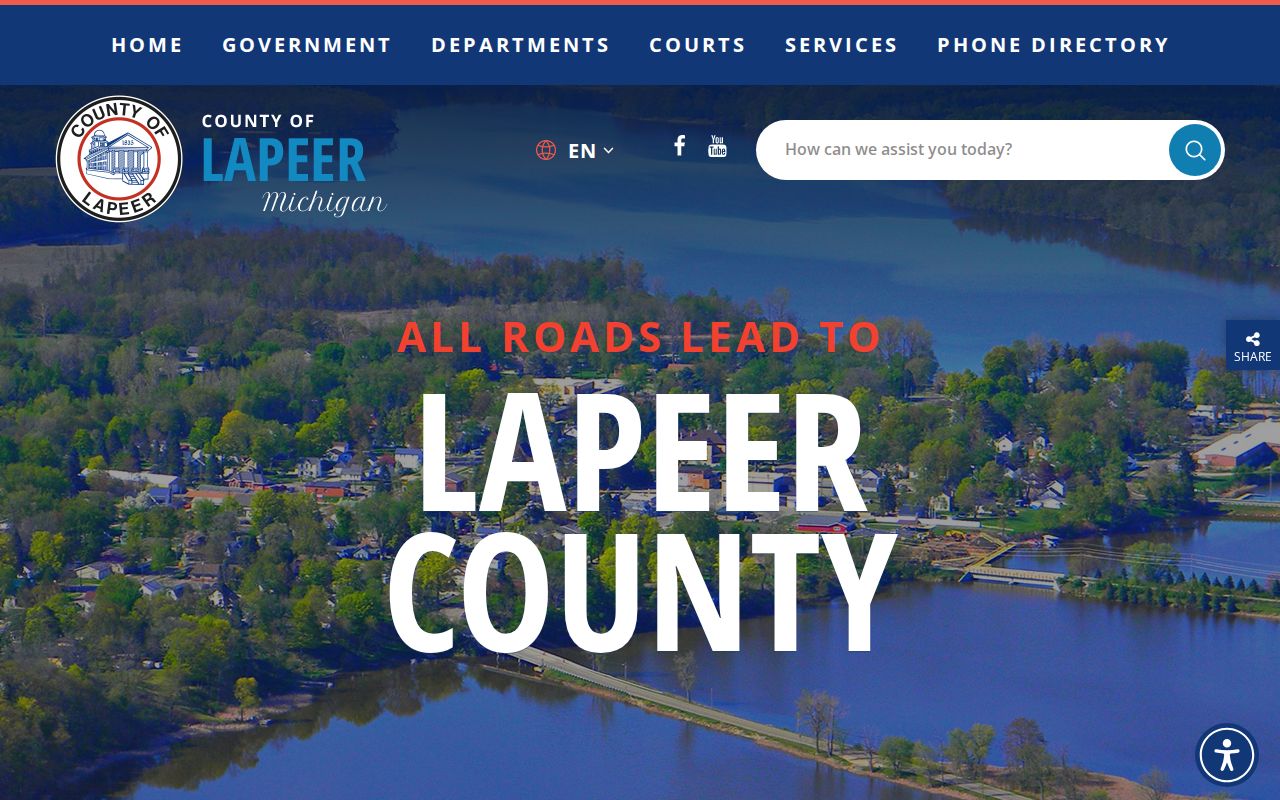
That separation explains why court, police, jail, and county administration requests do not all go to the same desk.
Four Lapeer County Record Searches
Four official systems cover most public record needs, but their boundaries matter. MiCOURT shows public trial-court case information. ICHAT compiles reportable Michigan criminal-history events submitted to the Criminal Justice Information Center. The Sheriff’s Office keeps county arrest reports and jail custody data. OTIS covers Michigan prison and adult felony supervision records. A searcher may need more than one because each product answers a different question.
| Channel | Best Use | Key Limit |
|---|---|---|
| MiCOURT | Filed charges, events, outcomes, and hearings | It is informational, not the official court file |
| ICHAT | Public Michigan reportable criminal history | No warrants, local misdemeanors, or other-state cases |
| Sheriff and jail | County reports, bookings, custody, bond, and release | No open official web roster |
| OTIS | State prison, parole, and adult felony probation | No county-jail-only sentence or unsentenced case |
PSOR is a fifth, narrow source for published registrants. It is not a general criminal record index. The best sequence depends on whether the goal is to review a court outcome, confirm recent custody, inspect one’s own repository result, or understand state supervision.
Note: A no-record result in one Lapeer County channel does not prove that every other official record source is also blank.
Official Michigan Background Checks
The Michigan State Police Criminal Justice Information Center runs ICHAT, the official public name-based check. It uses first name, last name, sex, date of birth, and other descriptors. Each search costs $10, even when it returns no public record. ICHAT can report Michigan felonies and serious misdemeanors punishable by more than 93 days when those events were sent to CJIC and remain public. It excludes warrants, federal and tribal matters, traffic cases, juvenile records, suppressed events, local misdemeanors, and records from other states.
Michigan State Police explains its criminal-history options, including the limits of name and fingerprint checks.
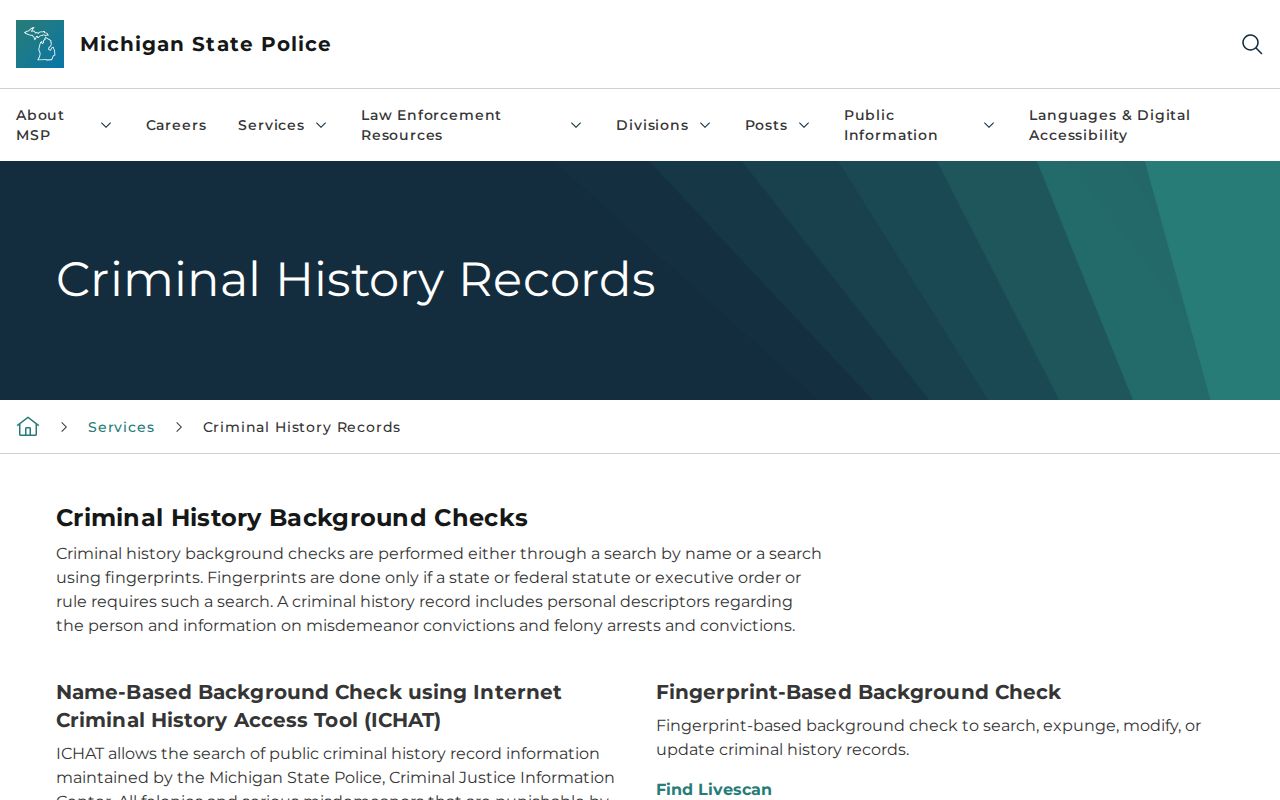
The state explanation helps Lapeer County readers choose ICHAT for a public name check and an authorized Live Scan route when fingerprints are legally required or used to review and correct one’s own record.
| ICHAT Item | Requirement or Result |
|---|---|
| First and last name | Required legal-name search fields |
| Sex and date of birth | Required descriptors that help distinguish matches |
| Race | Portal-dependent refining descriptor |
| Public product | Reportable, nonsuppressed Michigan history submitted to CJIC |
| Price | $10 for each search, including a no-record response |
A fingerprint check is not an unrestricted public upgrade from ICHAT. Michigan-authorized Live Scan vendors and law-enforcement agencies capture prints for uses authorized by statute, order, or rule. For personal review, correction, or a set-aside filing, follow the specific MSP instructions for that process.
Lapeer County Felony Case Records
A felony can leave two related case trails. The 71A District Court handles the complaint, arraignment, bond, probable-cause conference, and preliminary examination or waiver. If probable cause is established and the matter is bound over, the Lapeer County Prosecuting Attorney files the felony in 40th Circuit Court. Circuit Court then handles the plea or trial, sentence, and later motions.
This split is a common reason a search seems to stop too soon. A District Court record may end with a bindover rather than a final outcome. Continue in Circuit Court, and use the newer case number when it appears. Conversely, a Circuit Court result may not show every early event that remains in the District Court register of actions. The full local flow is:
Police request → prosecutor review → 71A arraignment → probable-cause stage → 40th Circuit bindover → disposition and sentence.
The main felony record counter is the 40th Circuit Court clerk in Suite 227 of the County Complex, 255 Clay Street. It is open Monday through Friday from 8:00 a.m. to 4:30 p.m., and its number is 810-667-0358. District Court can be reached at 810-667-0314.
Types of Criminal Records
Lapeer County agencies create separate records as an event moves from investigation to a final result. A police narrative tells what an officer saw, learned, or collected. A booking record documents intake and custody. The prosecutor’s charge decision can differ from the booked allegation. The court file then tracks what was formally filed and how it ended. State systems receive only the parts their laws and reporting rules allow.
- Incident report
- The investigating agency’s narrative, party information, observations, evidence references, and case status.
- Booking record
- Jail intake data, booked charges, bond, custody status, and release or transfer information.
- Register of actions
- The court’s dated list of filings, hearings, orders, pleas, judgment, and later case activity.
- ICHAT record
- The state repository’s public compilation of eligible Michigan events, not a copy of the whole court file.
- OTIS record
- An MDOC record for prison or adult felony supervision, not an index of all county convictions.
Warrants use another path. ICHAT expressly excludes them, while Michigan’s LEIN network is restricted to law enforcement. Registry profiles also stand apart because PSOR publishes only information authorized under the Sex Offenders Registration Act. The Lapeer County sex offender check explains that limited public system in context.
Michigan’s criminal-history collection law describes how arrest information reaches the state repository.
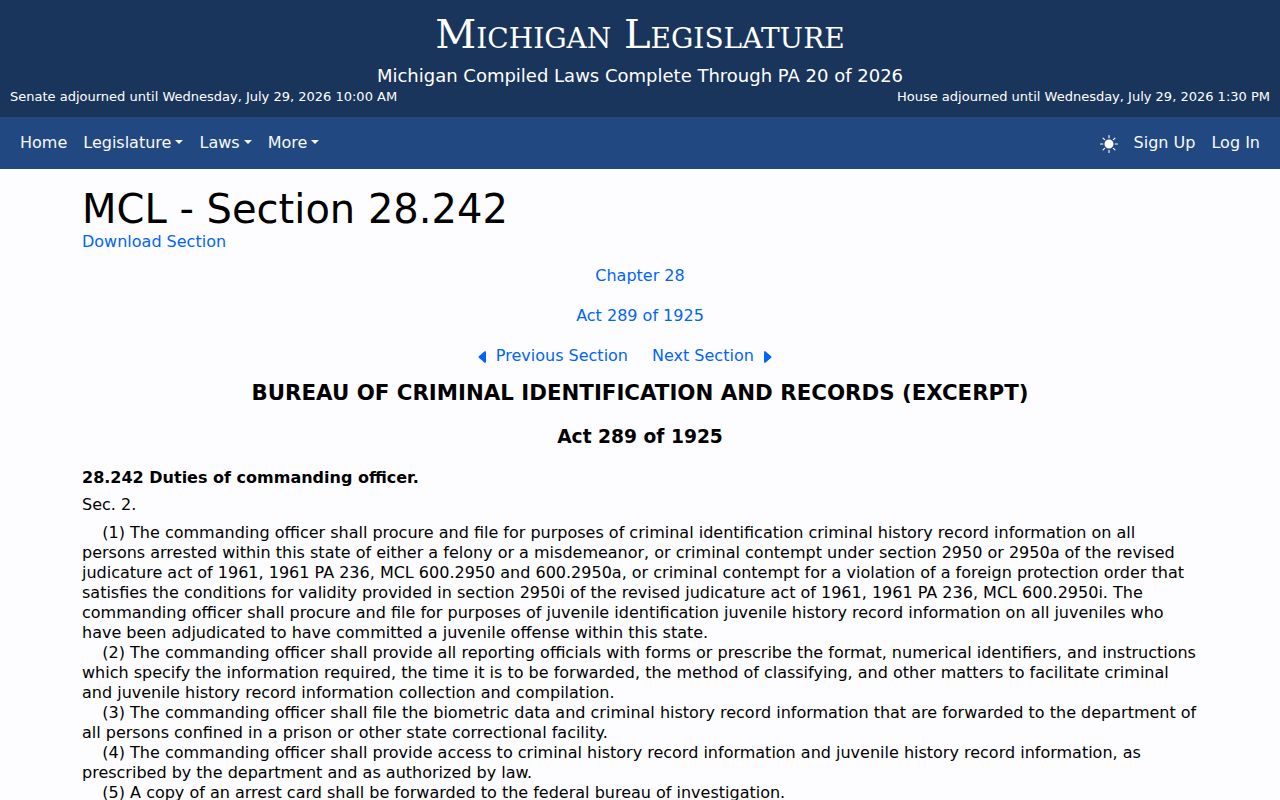
The law helps explain why an arrest cycle can appear in a state history while the local agency and court still hold the fuller source documents.
Lapeer County Custody Records Compared
Two John Conley Drive addresses can send a search down the wrong path. The Lapeer County Jail and Sheriff’s Office are at 3231 John Conley Drive. Thumb Correctional Facility is next door at 3225. The jail is a county facility for bookings and local custody. Thumb Correctional is an MDOC Level II state prison for sentenced people in state custody. It opened in 1987 and has seven general-population units.
Call the Sheriff at 810-664-1801 for county jail custody, booking, bond, and release or transfer questions. Search OTIS for a person in state prison or under adult felony probation or parole. A county-jail-only sentence will not create an OTIS prison record. A transfer to MDOC may cause the county jail record to show release or transfer while OTIS becomes the better current source.
MDOC describes OTIS and its record scope.
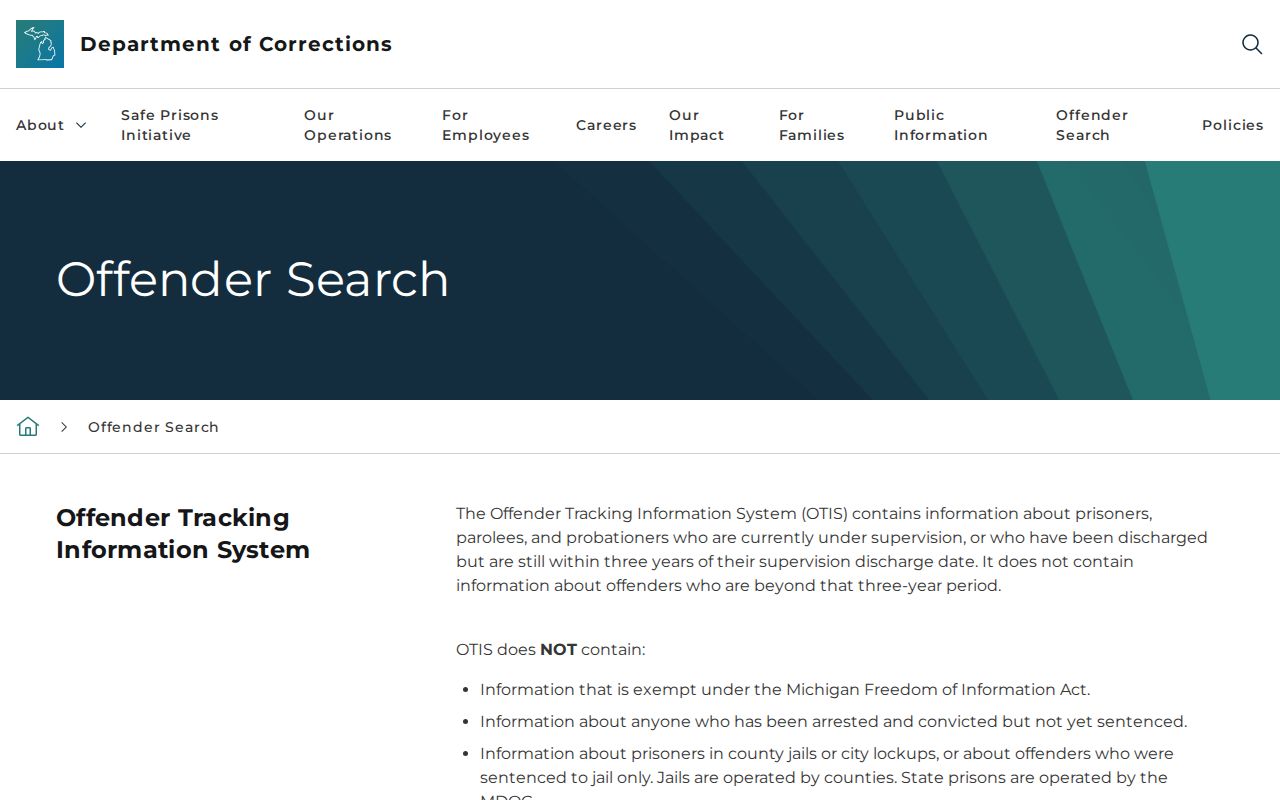
The state locator distinguishes prison and felony-supervision information from the booking files kept by the Lapeer County Sheriff.
What a Lapeer County Criminal Record Shows
The fields depend on the source. A public ICHAT result may combine personal descriptors with an arrest cycle, reportable charge, prosecutor or court information, disposition, and sentence that CJIC received. A MiCOURT result can add case number, filing date, charge sequence, MCL citation, hearings, jurist, and register-of-actions events. The Sheriff’s booking data deals with custody at a specific point in time.
| Name & Identifiers | Legal name, aliases or prior names, date of birth, sex, race, and limited personal descriptors where public. |
|---|---|
| Arrest / Booking Data | Arrest date, agency, booking number, intake time, booked allegations, bond, custody, and release or transfer. |
| Charges & Statutes | Offense text, MCL citation, count or sequence, and felony or misdemeanor label. |
| Disposition | Dismissal, plea, conviction, acquittal, deferral, or another formal case result. |
| Sentence | Jail or prison term, probation, fines, costs, and other public judgment terms. |
| Custody / Supervision | County jail status or MDOC prison, parole, and adult felony-probation status in the proper system. |
A booked charge is not the final charge. The prosecutor may decline, add, reduce, or amend counts, and the court’s disposition controls the legal outcome. For a record that looks wrong, compare ICHAT with a certified register of actions or judgment from the sentencing court. Court-related errors normally need correction at the court before CJIC can reflect the right result.
Lapeer County Jail Record Fallbacks
The Sheriff’s official website does not publish an open-browser inmate list, daily arrest blotter, searchable booking database, or public sample inmate profile. That absence is important. Unofficial roster sites should not replace the agency that holds the record. Start with the jail phone, corrections information, or a written county FOIA request. Give the full name and birth date if known, then ask for booking number, booked charges, bond, court, custody, and release or transfer status.
The official Sheriff’s Office page identifies the headquarters, divisions, and approved mobile channel.
The Sheriff’s Records Division and Corrections staff fill the local gap left by the lack of a public Lapeer County roster.
The Lapeer County Sheriff-MI app is available through the Apple App Store. Check its current modules rather than assuming it offers live inmate search. For final charges and the disposition, move from the booking information to MiCOURT and the proper clerk. The detailed Lapeer County arrest history route follows each official channel without republishing arrest photos or names.
Public Access Laws
Michigan FOIA applies to records held by public bodies such as the county and Sheriff’s Office. It gives a person the right to inspect or obtain nonexempt public records when the request describes them well enough to locate. Courts are not public bodies under that same FOIA route for judicial files. Ask the court clerk for a case record under the court’s access rules. Protected case types, sealed matters, juvenile material, victim data, private identifiers, and parts of active investigations can remain unavailable.
Key Michigan laws:
MCL 15.231 states Michigan’s policy favoring public information about government acts.
MCL 15.233 supplies the right to inspect, copy, or receive nonexempt public records.
MCL 15.235 sets the initial response period and one allowed extension.
MCL 15.243 lists exemptions, including privacy, investigation, source, technique, and safety concerns.
The Lapeer County Clerk’s official page identifies the office that maintains Circuit Court files.
The clerk remains the source for official felony documents and certified copies even when a public case entry appears online.
Lapeer County Record Request Clock
A written county request may be sent by letter, fax, email, or in person. Mark it “FOIA” or “FOIA Request” and name the department. Describe the incident, report, booking, location, date range, and desired parts. County Administration receives mailed requests at 255 Clay Street, Suite 301, Lapeer, MI 48446. Its fax is 810-667-0369, and the published email is dclark@lapeercounty.org. A Sheriff record should name the Lapeer County Sheriff’s Office as the department.
Within five business days, the county may grant, deny, grant in part, take one ten-business-day extension, or point to a record that is already free online. Email and fax requests are treated as received on the next business day. If expected cost exceeds $50, the county may seek a 50% good-faith deposit. Standard letter or legal paper cannot exceed $0.10 per sheet. Search, review, redaction, media, mailing, and permitted labor costs may also apply.
Lapeer County publishes its FOIA forms and policy online.
The county material is the right starting point when a Sheriff report or jail document is not available through a public search.
Ask for segregable nonexempt portions when only part of a record is withheld. An active investigation, victim details, juvenile information, a private identifier, or safety concern may justify redaction. The written denial should state the legal basis and appeal rights.
Sealed, Expunged & Restricted
Michigan calls statutory conviction relief “setting aside,” though expungement and Clean Slate are also common terms. Application-based relief is filed in the court of conviction. Eligibility depends on the number and kind of convictions, offense exclusions, and the applicable waiting period. The local route is 71A District Court for a misdemeanor conviction and 40th Circuit Court for a felony conviction.
An application packet can require the statewide form, fingerprints, a certified judgment or probation order and register of actions, service on the prosecutor and Attorney General, and a $50 MSP processing payment. MSP advises allowing eight weeks for its criminal-history processing and mailing. Current forms and court requirements should be checked before filing. Automatic Clean Slate under MCL 780.621g can remove eligible convictions from public view after the statutory period and within numerical limits, but not every old case qualifies.
When a Lapeer County case vanishes from a public search, a set-aside, protected case type, display window, or data gap may explain the result. Do not assume deletion or error. The clerk can confirm whether a public file exists, while MSP handles the state record once the required court action and reporting are complete.
Lapeer County Warrant Records Bypass ICHAT
ICHAT does not show warrants, and LEIN is not open to public searching. Lapeer County also does not advertise a full public warrant database. A MiCOURT event may say that a warrant was issued, but that entry cannot prove it remains active. Status can change when a court recalls the warrant or law enforcement serves it.
Use direct verification for one’s own warrant. Call 71A District Court at 810-667-0314 for misdemeanor, traffic, and felony-preliminary matters. Call 40th Circuit Court at 810-667-0358 for a post-bindover felony. Sheriff nonemergency can be reached at 810-667-0292 or headquarters at 810-664-1801. Staff may require an in-person appearance or coordination through counsel, and a FOIA response may omit operational details.
Note: Do not rely on an old docket event alone when deciding whether a Lapeer County warrant is still active.
Lapeer County Supervision Records in OTIS
Supervision is split. The 71A District Court Probation Department handles misdemeanor supervision from that court. MDOC Field Operations supervises adult felony probationers and parolees, while the Michigan Parole Board decides parole for eligible prisoners. Thumb Area Regional Community Corrections supplies local alternatives and programming that may produce public court entries, though treatment details can remain restricted.
OTIS supports a name or MDOC-number search and can refine by sex, age, race, status, and scars, marks, or tattoos. It covers current prisoners, parolees, probationers, and people discharged within the prior three years. It omits county-jail-only cases, unsentenced people, and older discharged records. For older MDOC material, the research route is MDOC Records Retention at 517-780-5471 or MDOC-Records_Retention@michigan.gov with name, birth date, and MDOC number if known.
A probation violation event in MiCOURT and an OTIS absconder or status field are different records. Verify a court event with the clerk and a supervision status with the assigned office. Sentencing errors normally return to the sentencing court; supervision-status errors go to the supervising agent or office.
Criminal Records by City in Lapeer County
City police departments keep the reports their officers create, while county courts and the county jail hold later parts of the same matter. Lapeer and Imlay City have their own police request routes but no separate municipal criminal courts. Brown City spans Sanilac County and a small part of Lapeer County, so the incident location determines which county court and jail should be searched.
Lapeer Criminal History
9,146 estimated residents in 2024 · City police reports route through the city, while cases go to 71A and 40th Circuit.
Imlay City Criminal History
3,703 residents in 2020 · City police hold narratives, with county jail and court follow-through in Lapeer.
Brown City Criminal History
1,290 citywide residents in 2020 · The cross-county boundary makes incident location essential.
The city cards route to the three incorporated cities identified in the county research. Villages are not substituted for cities, even when a village has more residents within Lapeer County than Brown City’s small local portion.
Lapeer County Court Records Moved
The historic courthouse on Courthouse Square began in 1845 and is described by the county as Michigan’s oldest courthouse still used for its original purpose. It remains part of Lapeer County’s civic identity. Modern felony file requests, however, go to the County Complex behind it rather than to a presumed records desk in the historic building.
The move from the old courthouse to the modern complex reflects the growth of court and administrative work. Today, the 40th Circuit clerk in Suite 227 maintains files, supplies copies and certifications, keeps motion dockets, and attends court proceedings. This is also the fallback when MiCOURT’s display window or digital coverage leaves out older public material.
Michigan’s public-record policy frames access to government records.
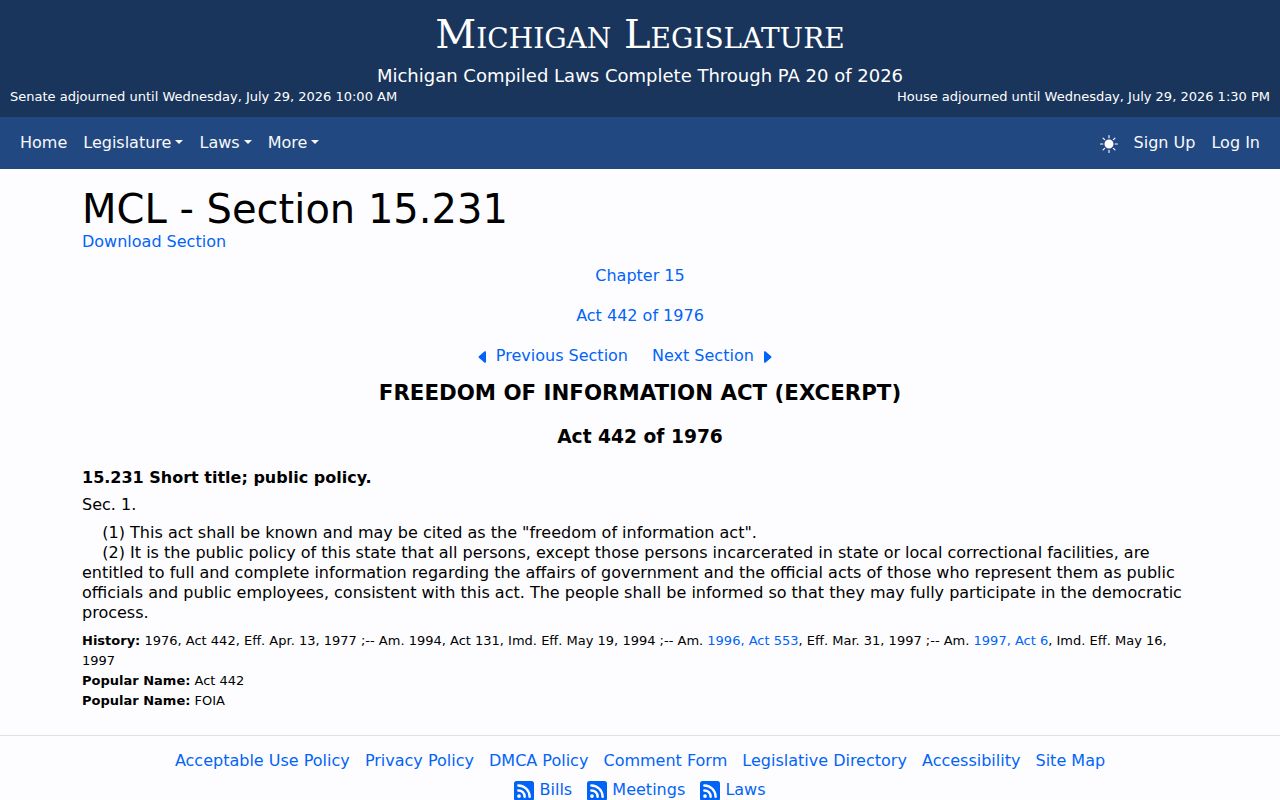
The statute supports public access, while the courthouse and agency rules still determine where a particular Lapeer County record must be requested.